

ASUS has released a 12.3-inch gaming monitor |
|
 |
|
|
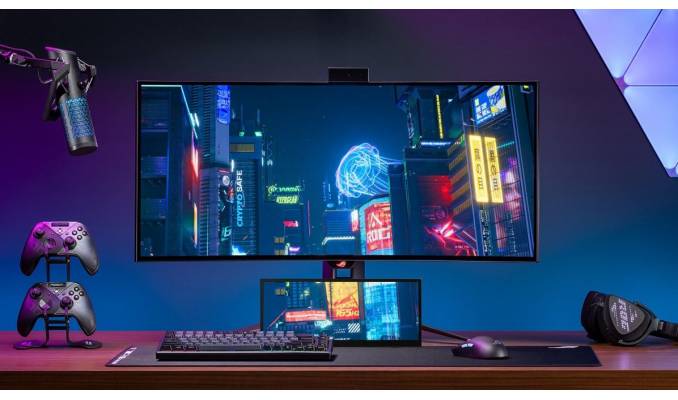
ASUS has added the compact ROG Strix XG129C secondary display to its lineup, designed for streamers, gamers, and anyone who constantly runs out of space on their main monitor. The company has even secured the support of the developers of the popular AIDA64 Extreme utility. In concept, the ROG Strix XG129C resembles the Elgato Stream Deck or the Corsair Xenon Edge. The new model features a 12.3-inch touchscreen IPS  In Plane Switching (IPS) panels are an expensive option but they have excellent colour accuracy and far greater viewing angles then TN and VA panels (Not that we condone slouching while gaming). They are great for graphics design and photo editing. However, the only downside to IPS panels if that they can sometimes have a slower response time than TN panels. This is the only real problem if you’re a very competitive gamer or want to game in 3D. As of late “IPS” has become a big marketing word. Step into an Apple store and you would be hard pressed talking to someone that didn’t mention Apple’s “brand new IPS Displays!” In fact, Apple is probably one of the biggest marketers of this “new-found” technology. As a business person myself, this is when you have to tip your hat to Apple’s awesome marketing machine. Why? Well, because IPS is actually nothing new. In fact, this technology was originally invented in 1996 by Hitachi..display with a resolution of 1920x720 pixels. It comes in an unusual 24:9 aspect ratio, which, according to ASUS, is more convenient than the popular 32:9 widescreen panels: the screen displays more information vertically and leaves fewer black bars when watching videos. The display supports 10-point multitouch and a 75 Hz refresh rate. In Plane Switching (IPS) panels are an expensive option but they have excellent colour accuracy and far greater viewing angles then TN and VA panels (Not that we condone slouching while gaming). They are great for graphics design and photo editing. However, the only downside to IPS panels if that they can sometimes have a slower response time than TN panels. This is the only real problem if you’re a very competitive gamer or want to game in 3D. As of late “IPS” has become a big marketing word. Step into an Apple store and you would be hard pressed talking to someone that didn’t mention Apple’s “brand new IPS Displays!” In fact, Apple is probably one of the biggest marketers of this “new-found” technology. As a business person myself, this is when you have to tip your hat to Apple’s awesome marketing machine. Why? Well, because IPS is actually nothing new. In fact, this technology was originally invented in 1996 by Hitachi..display with a resolution of 1920x720 pixels. It comes in an unusual 24:9 aspect ratio, which, according to ASUS, is more convenient than the popular 32:9 widescreen panels: the screen displays more information vertically and leaves fewer black bars when watching videos. The display supports 10-point multitouch and a 75 Hz refresh rate.One of the main features is integration with AIDA64 Extreme. Along with the monitor, users receive a one-year subscription to the utility with exclusive ROG SensorPanel themes. Thanks to this, the XG129C can be turned into a full-fledged PC monitoring panel displaying temperature, frequencies, voltages, and component load in real time. Along with the mini-display, ASUS also unveiled a new gaming monitor, the ROG Strix OLED OLED technology was invented by Eastman Kodak in the early 1980s. OLED panels are made from organic (carbon based) materials that emit light when electricity is applied through them. Since OLEDs do not require a backlight and filters (unlike LCD displays), they are more efficient, simpler to make, and much thinner. OLEDs have a great picture quality - brilliant colors, fast response rate and a wide viewing angle. OLEDs can also be used to make OLED lighting - thin, efficient and without any bad metals.XG34WCDMS, featuring a 34-inch QD-OLED panel, a resolution of 3440x1440 pixels, and a refresh rate of 280 Hz. The company has not yet disclosed pricing for either new product.
|