
Philips has released the Evnia 32M2N8900X QD-OLED monitor with Ambiglow backlighting and a 240 Hz refresh rate |
|
 |
|
|
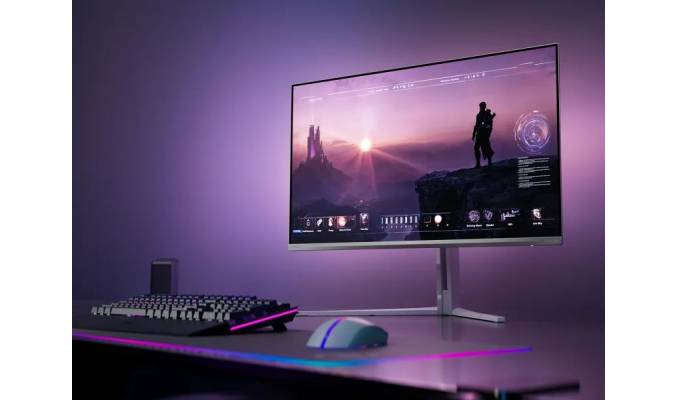
Philips has released the new Evnia 32M2N8900X gaming monitor. This 31.5-inch model features a QD-OLED panel with a high refresh rate, an anti-glare coating, and RGB backlighting that extends the image beyond the screen's edges. The monitor features a screen with a resolution of 3840x2160 pixels and a refresh rate of up to 240 Hz. It supports DisplayHDR True Black 500, the ClearMR 13000 standard, and Adaptive-Sync. The response time is 0.03 ms. Thanks to the RGB Q-Stripe subpixel structure, text appears crisp and free of color halos, unlike in previous generations of OLED  OLED technology was invented by Eastman Kodak in the early 1980s. OLED panels are made from organic (carbon based) materials that emit light when electricity is applied through them. Since OLEDs do not require a backlight and filters (unlike LCD displays), they are more efficient, simpler to make, and much thinner. OLEDs have a great picture quality - brilliant colors, fast response rate and a wide viewing angle. OLEDs can also be used to make OLED lighting - thin, efficient and without any bad metals.monitors. The screen features a 3H anti-glare coating, which also protects against scratches. The presence of a graphene layer for heat dissipation is specifically noted: it is intended to reduce degradation of the OLEDOLED technology was invented by Eastman Kodak in the early 1980s. OLED panels are made from organic (carbon based) materials that emit light when electricity is applied through them. Since OLEDs do not require a backlight and filters (unlike LCD displays), they are more efficient, simpler to make, and much thinner. OLEDs have a great picture quality - brilliant colors, fast response rate and a wide viewing angle. OLEDs can also be used to make OLED lighting - thin, efficient and without any bad metals.matrix during prolonged use. OLED technology was invented by Eastman Kodak in the early 1980s. OLED panels are made from organic (carbon based) materials that emit light when electricity is applied through them. Since OLEDs do not require a backlight and filters (unlike LCD displays), they are more efficient, simpler to make, and much thinner. OLEDs have a great picture quality - brilliant colors, fast response rate and a wide viewing angle. OLEDs can also be used to make OLED lighting - thin, efficient and without any bad metals.monitors. The screen features a 3H anti-glare coating, which also protects against scratches. The presence of a graphene layer for heat dissipation is specifically noted: it is intended to reduce degradation of the OLEDOLED technology was invented by Eastman Kodak in the early 1980s. OLED panels are made from organic (carbon based) materials that emit light when electricity is applied through them. Since OLEDs do not require a backlight and filters (unlike LCD displays), they are more efficient, simpler to make, and much thinner. OLEDs have a great picture quality - brilliant colors, fast response rate and a wide viewing angle. OLEDs can also be used to make OLED lighting - thin, efficient and without any bad metals.matrix during prolonged use.The panel delivers up to 300 nits of brightness in SDR (at 100% APL), up to 515 nits in HDR HDR stands for High Dynamic Range imaging, and it is an old photography practice recently introduced to cameraphones like the iPhone and some Android devices (or with the use of special apps). (10% APL), and a peak of 1000 nits in small areas of active pixels. It also features 10-bit color reproduction and the ability to display 100% sRGB and 99.5% DCI-P3, with sRGB accuracy at a Delta E of less than 2.Additional features include Ambiglow three-sided ambient lighting, a built-in KVM switch, PiP/PbP modes, and built-in audio with two 5-watt speakers and DTS Sound support. The monitor features two HDMI 2.1 ports, one DisplayPort 2.1 port, a USB Type-C With the continued success of the USB interface, there exists a need to adapt USB technology to serve newer computing platforms and devices as they trend toward smaller, thinner and lighter form-factors. Many of these newer platforms and devices are reaching a point where existing USB receptacles and plugs are inhibiting innovation, especially given the relatively large size and internal volume constraints of the Standard-A and Standard-B versions of USB connectors. port with video output and up to 65W power delivery, as well as additional USB ports and an audio output.No information is available yet regarding the monitor's price or release date. |