
Xiaomi Redmi K50i specs.
Mobiles >> Xiaomi >> Xiaomi Redmi K50i| Specifications | Reviews | Secret codes |
| Unlock phone | Root phone |
| Backup | Flash Firmware | Screenshot |
| Bypass Xiaomi Account Verification |
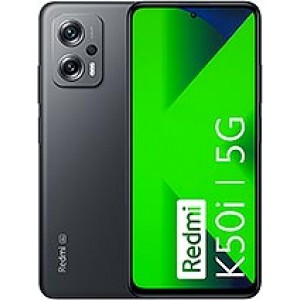
Basic Spec Xiaomi Redmi K50i
Smart Phone OS: An operating system (OS) is software that interacts between a user and a smartphone.
An operating system (OS) is software that interacts between a user and a smartphone.Android 12, MIUI 13
Chipset:Is a set of chips in the smartphone that control the CPU.
Is a set of chips in the smartphone that control the CPU.MediaTek Dimensity 8100 (5 nm)
CPU:Central processing unit
Central processing unitOcta-core (4x2.85 GHz Cortex-A78 & 4x2.0 GHz Cortex-A55)
GPU:Graphics Processing Unit
Graphics Processing UnitMali-G610 MC6
Display Xiaomi Redmi K50i
Type:
FFS LCD, 144Hz, HDR10, Dolby Vision, 500 nits (typ), 650 nits (HBM)
Screen Size:This diagonal display size is usually measured in inches.
This diagonal display size is usually measured in inches.6.6 inches, 103.4 cm2 (~85.1% screen-to-body ratio)
Screen Resolution:Screen resolution refers to the size of the image received on the screen in pixels
Screen resolution refers to the size of the image received on the screen in pixels1080 x 2460 pixels (~407 ppi density)
Protection:
Corning Gorilla Glass 5
Storage Xiaomi Redmi K50i
Card slot:
No
Internal:
128GB 6GB RAM, 128GB 8GB RAM, 256GB 8GB RAMRandom Access Memory
Random Access MemoryMain Camera Xiaomi Redmi K50i
Triple camera:
64 MP, f/1.9, (wide), 1/1.72", 0.8µm, PDAF
8 MP, f/2.2, 120˚, (ultrawide)
2 MP, f/2.4, (macro)
8 MP, f/2.2, 120˚, (ultrawide)
2 MP, f/2.4, (macro)
Features:
LED flash, HDR, panorama
Video:
4K@30fps, 1080p@30/60fps
Selfie camera Xiaomi Redmi K50i
Single camera:
16 MP, f/2.5, (wide)
Video:
1080p@30fps
Sound Xiaomi Redmi K50i
Loudspeaker:
Yes, with stereo speakers
3.5mm jack:
Yes
Network connectivity Xiaomi Redmi K50i
Technology:
GSM / HSPAHigh Speed Packet Access / LTE / 5G
High Speed Packet Access / LTE / 5G2G:Second generation cellular network
Second generation cellular networkGSM 850 / 900 / 1800 / 1900 - SIM 1 & SIM 2
3G:Third generation cellular network
Third generation cellular networkHSDPAHigh-Speed Downlink Packet Access 850 / 900 / 1700(AWS) / 1900 / 2100
High-Speed Downlink Packet Access 850 / 900 / 1700(AWS) / 1900 / 2100 4G:Fourth generation cellular network
Fourth generation cellular network1, 2, 3, 4, 5, 7, 8, 20, 28, 38, 40, 41
5G bands:
1, 3, 5, 7, 8, 20, 28, 38, 40, 41, 77, 78 SA/NSA
Speed:
HSPAHigh Speed Packet Access 42.2/5.76 Mbps, LTE-A (CA), 5G
High Speed Packet Access 42.2/5.76 Mbps, LTE-A (CA), 5GWLAN:Wireless Local Area Network
Wireless Local Area NetworkWi-Fi 802.11 a/b/g/n/ac/6, dual-band, Wi-Fi Direct, hotspot
Bluetooth:Bluetooth is used to exchange data between nearby mobile devices.
Bluetooth is used to exchange data between nearby mobile devices.5.3, A2DP, LE
GPS:Global Positioning System
Global Positioning SystemYes, with A-GPSAssisted Global Positioning System. Up to dual-band: GLONASSGLObal NAvigation Satellite System (1), BDS (2), GALILEOEuropean Global Navigation Satellite System (1), QZSSQuasi-Zenith Satellite System
Assisted Global Positioning System. Up to dual-band: GLONASSGLObal NAvigation Satellite System (1), BDS (2), GALILEOEuropean Global Navigation Satellite System (1), QZSSQuasi-Zenith Satellite SystemNFC:Near field communication
Near field communicationNo
Infrared port:
Yes
Radio:
No
USB:Universal Serial Bus
Universal Serial BusUSB Type-C 2.0, USB On-The-Go
Phone features Xiaomi Redmi K50i
Sensors:
Fingerprint, accelerometer, proximity, gyro, compass, color spectrum
Battery Xiaomi Redmi K50i
Type:
Li-Po 5080 mAh, non-removable
Charging:
Fast charging 67W, 50% in 15 min, 100% in 46 min (advertised)
Size Xiaomi Redmi K50i
Dimensions:
163.6 x 74.3 x 8.9 mm (6.44 x 2.93 x 0.35 in)
Weight:
200 g (7.05 oz)
SIM:
Dual SIM (Nano-SIM, dual stand-by)
Comments, Questions and Answers about Xiaomi Redmi K50i
Ask a question about Xiaomi Redmi K50i
Honor has added the mid-range Play 80 Plus smartphone to its lineup, featuring a high-capacity battery, an IPS display, and a Snapdragon processor. It also features a dedicated button for accessing AI functions.
Following the Play 70C, Play 80 Plus, and Play 11C, Honor has released a new smartphone in the series?the 11 Plus. Its key features include an AMOLED screen with a high PWM frequency and a high-capacity battery, combined with a slim body.

Following the launch of its new tablet, HUAWEI has introduced the nova 15 Max smartphone to the global market. The device emphasizes long battery life and advanced photography capabilities, allowing users to capture high-quality images even at night.