ASUS unveils new Vivobook Pro with OLED screen and powerful NPU |
|
 |
|
|
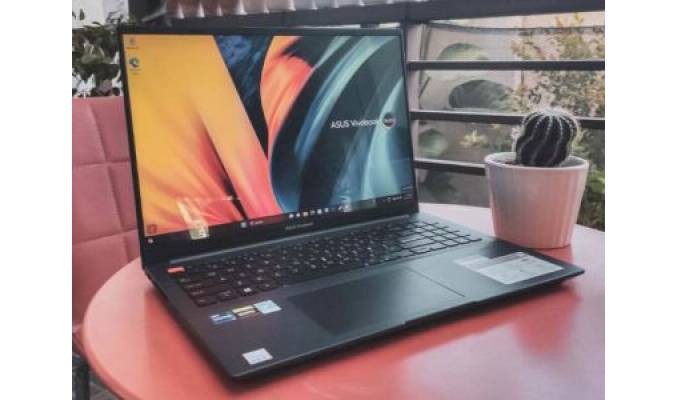
The ASUS laptop series has a new addition. The Vivobook Pro 16 (2026) model, available in 14- and 16-inch versions, is equipped with an OLED  OLED technology was invented by Eastman Kodak in the early 1980s. OLED panels are made from organic (carbon based) materials that emit light when electricity is applied through them. Since OLEDs do not require a backlight and filters (unlike LCD displays), they are more efficient, simpler to make, and much thinner. OLEDs have a great picture quality - brilliant colors, fast response rate and a wide viewing angle. OLEDs can also be used to make OLED lighting - thin, efficient and without any bad metals.display with accurate color reproduction, as well as powerful Intel hardware for everyday tasks and local neural network training. OLED technology was invented by Eastman Kodak in the early 1980s. OLED panels are made from organic (carbon based) materials that emit light when electricity is applied through them. Since OLEDs do not require a backlight and filters (unlike LCD displays), they are more efficient, simpler to make, and much thinner. OLEDs have a great picture quality - brilliant colors, fast response rate and a wide viewing angle. OLEDs can also be used to make OLED lighting - thin, efficient and without any bad metals.display with accurate color reproduction, as well as powerful Intel hardware for everyday tasks and local neural network training.The 16-inch version has a display with a resolution of 2.5K and a refresh rate of 165 Hz. The matrix has full coverage of the DCI-P3 color standard (ΔE ≤ 1), and the peak brightness of the backlight is 1100 cd/m². For reading enthusiasts, there is a monochrome ?e-book mode.? The performance of the new product is provided by a 16-core Intel Core Ultra X7 358H processor with an NPU module (total AI performance up to 180 TOPS). This allows the laptop to support local image generation, voice control, and document summarization functions. The RAM Random Access Memory (RAM) is the place in a computer where the operating system, application programs, and data in current use are kept so that they can be quickly reached by the computers processor. capacity is 32 GB (LPDDR5X), the storage capacity (PCIe 4.0) is 1 TB, and the total heat dissipation of the hardware is 85 W. Battery life is provided by an 80 Wh battery (up to 20 hours of video playback) with fast charging (50% in 30 minutes). The body has two USB 3.2 Type-A ports, as well as one USB 3.2 Type-C, Thunderbolt 4, and HDMI 2.1 port each. A combined 3.5 mm audio port is provided for connecting a headset.The 14-inch model features a 2.8K OLED OLED technology was invented by Eastman Kodak in the early 1980s. OLED panels are made from organic (carbon based) materials that emit light when electricity is applied through them. Since OLEDs do not require a backlight and filters (unlike LCD displays), they are more efficient, simpler to make, and much thinner. OLEDs have a great picture quality - brilliant colors, fast response rate and a wide viewing angle. OLEDs can also be used to make OLED lighting - thin, efficient and without any bad metals.screen with a refresh rate of 120 Hz. It is powered by an Intel Core Ultra 7 processor (model unspecified) with a TDP of up to 65 W, and the claimed battery life is up to 33 hours. Otherwise, the specifications are the same as those of the 16-inch version.ASUS Vivobook Pro 14 (2026) with a Core Ultra 7 processor, 32 GB of RAM Random Access Memory (RAM) is the place in a computer where the operating system, application programs, and data in current use are kept so that they can be quickly reached by the computers processor., and 1 TB of storage is sold in China for $1,006, while the higher-end model with the same configuration costs $1,050, and the version with a Core Ultra X7 358H chip costs $1,150.
|